Devolutions Survey Reveals SMBs' Cybersecurity Confidence Outpaces Capabilities
A recent global IT security survey by Devolutions highlights a significant gap between SMBs' confidence in handling cyber incidents and their actual security preparedness, with manual privileged access management and inconsistent training among the key challenges.
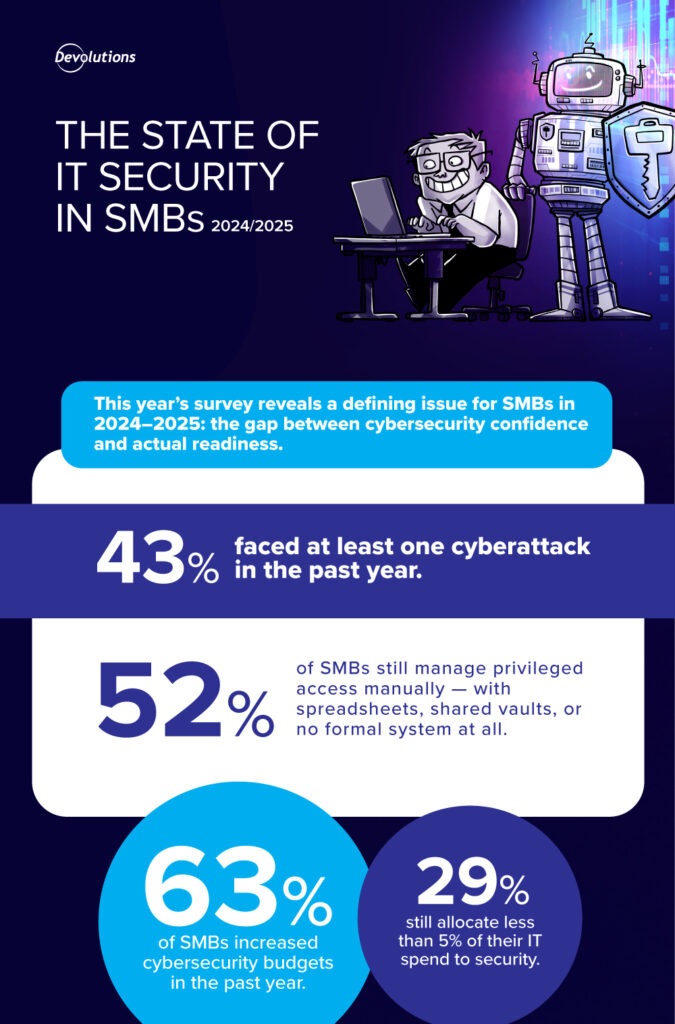
Devolutions, a provider of Privileged Access Management (PAM) and cybersecurity tools for small and mid-sized businesses (SMBs), has released its fifth annual global IT security survey. The findings reveal a concerning disparity between SMBs' confidence in their cybersecurity posture and their actual capabilities. While 71% of SMBs feel confident in handling a cyber incident, only 22% report having an advanced security posture.
The survey, which gathered responses from IT professionals worldwide, underscores the prevalence of manual processes in managing privileged access, with 52% of SMBs still relying on spreadsheets or shared vaults. Additionally, the adoption of AI in cybersecurity is slow, with 40% of respondents not using AI at all, despite 71% planning to increase its use. Budget constraints also play a role, as many SMBs allocate less than 5% of their IT spend to security.
Insider threats are another area of concern, with 78% of SMBs acknowledging the risk but only 20% having a formal strategy to address it. Training remains inconsistent, with only 39% of SMBs offering continuous cybersecurity education to their teams. These insights highlight the need for SMBs to operationalize their awareness of cybersecurity risks and invest in practical, scalable solutions.
Devolutions' survey not only sheds light on the current state of SMB cybersecurity but also informs the company's product development. The findings reinforce the importance of making PAM solutions more accessible and easier to adopt for SMBs, as well as enhancing training resources to address the why behind security decisions. The survey serves as a valuable resource for SMBs looking to benchmark their security practices and make informed improvements.