FTI Consulting Navigates Mixed Quarter with Strategic Buybacks and Leadership Transition
FTI Consulting's second-quarter results highlight divergent performance across business segments while maintaining aggressive stock repurchases and preparing for a CFO transition, signaling strategic positioning amid market challenges.
FTI Consulting reported steady second-quarter results with record performances in restructuring and communications divisions offsetting declines in technology and economic consulting units. The advisory firm's revenue reached $944 million, essentially unchanged from the previous year but exceeding Wall Street expectations, while earnings per share declined to $2.13 from $2.34. The company's aggressive stock buyback program and upcoming CFO transition have drawn significant investor attention as the firm navigates uneven market conditions.
The Corporate Finance & Restructuring segment led the quarter with revenue increasing 9% to a record $379 million, while Strategic Communications surprised analysts with a 21% jump to $103 million driven by corporate reputation and crisis work. Forensic and Litigation Consulting posted solid 10% growth to $187 million. However, these strong performances were tempered by Economic Consulting revenue dropping 17% with margins narrowing to 7%, and Technology segment revenue falling 28% due to fewer regulatory-driven discovery assignments.
FTI Consulting maintained its aggressive capital return strategy, repurchasing $355 million of stock in the second quarter and $540 million year-to-date. The company financed this program through increased debt, with total debt rising to approximately $470 million from $160 million in the prior quarter. Despite this increase, leverage remains modest at about 1.2 times gross debt to EBITDA. CFO Ajay Sabherwal emphasized that leverage represents "an outcome, not a target," highlighting management's opportunistic approach to capital deployment.
The upcoming CFO transition adds another layer of complexity to the company's strategic positioning. Sabherwal, who has served as CFO since 2016, is set to depart in September for a role outside consulting. Paul Linton, currently Chief Strategy and Transformation Officer, will serve as interim CFO. Analysts suggest continuity should be manageable, though Sabherwal's track record in capital discipline makes the transition particularly noteworthy for investors monitoring the company's financial strategy.
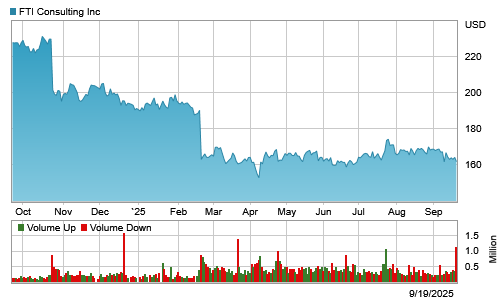
FTI shares currently trade around $163, representing approximately 22 times forward earnings and 14 times EBITDA, showing little change since July. This valuation suggests investors appreciate the company's stability and cash generation capabilities but remain cautious about pricing in a rebound from the weaker segments. Chief Executive Steven Gunby has characterized 2025 as a "tough year," with the mixed performance across business units reflecting the firm's strategy of investing through market cycles. The company's approach to maintaining buybacks while navigating segment-specific challenges demonstrates its commitment to shareholder returns amid evolving market conditions.
Management noted that current investments in senior hires and partnerships, while weighing on margins in the short term, are designed to support long-term growth. The divergent performance across business segments underscores the consulting industry's cyclical nature and FTI's positioning across multiple service lines. As the firm prepares for its leadership transition and continues its capital return program, investors will be watching how the company balances near-term challenges with long-term strategic investments. The mixed results highlight both the resilience of certain business lines and the headwinds facing others in the current economic environment.