Holiday Spending to Increase 6% as Consumers Prioritize Value and AI Adoption Grows
Consumers plan to spend 6% more this holiday season while demanding deeper discounts and increasingly using AI tools for shopping assistance, according to Simon-Kucher's annual report.
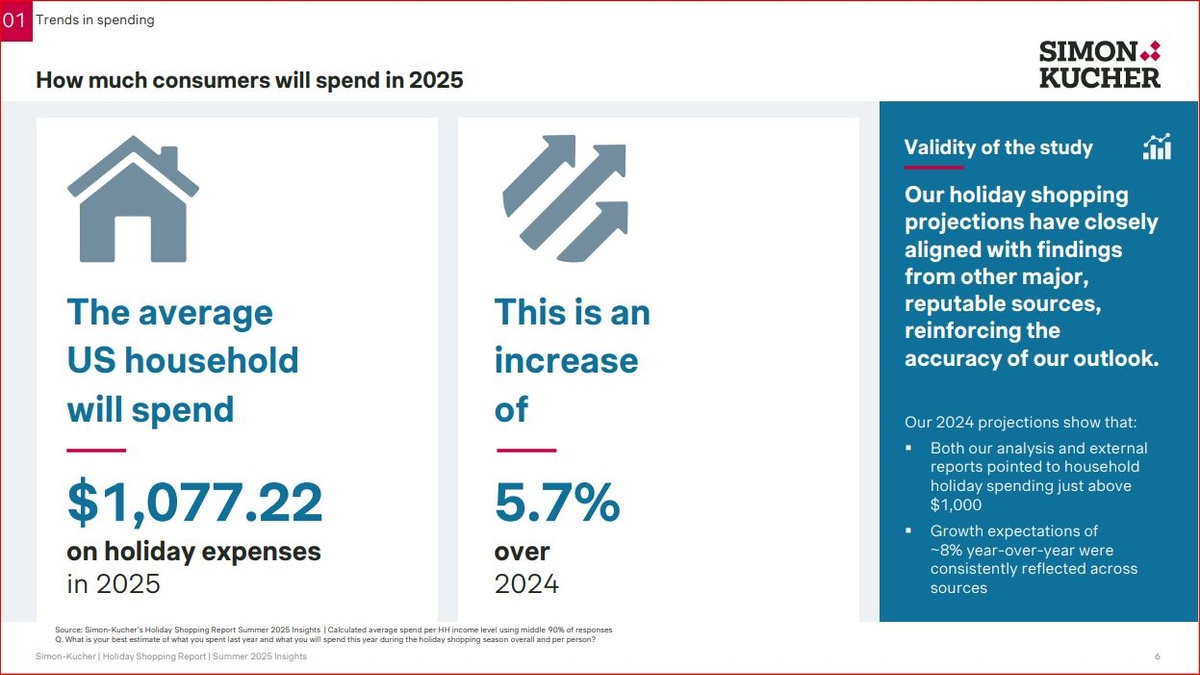
Holiday shoppers are projected to increase spending by 6 percent compared to last year, averaging $1,077 per household, according to Simon-Kucher's 7th Annual Holiday Shopping Report. The study reveals consumers are implementing stricter budgets while shifting focus toward quality and value rather than price alone across most retail categories.
Shikha Jain, Partner and Head of Consumer and Retail for North America for Simon-Kucher, noted that consumers are not seeking uniform discount strategies this season. Retailers must balance promotions with differentiated discounts to meet consumer expectations while maintaining profitability. Most consumers anticipate discounts up to 40 percent, with 25 percent discounts remaining common across various categories.
Spending patterns show category specificity, with over 50 percent of consumers spending more than $100 in high-value household appliances, home improvement, and electronics. Sixty-six percent of early holiday shoppers prefer Black Friday and other sales events, beginning shopping as early as July 4th through Super Saturday. Social media serves as an inspiration source for 64 percent of shoppers, while three out of four consumers return 10 percent or less of their purchases.
Artificial intelligence has gained significant traction in holiday shopping, with 54 percent of consumers using AI for shopping support. Specifically, 23 percent utilize AI for deal tracking and 27 percent for price comparisons, though older generations show reluctance to adopt AI tools for gift brainstorming. Max Walter, Director of Consumer and Retail for North America for Simon-Kucher, observed that AI is increasingly leveraged despite generational adoption and trust challenges.
External factors are influencing shopping behavior, with 44 percent of consumers expecting tariffs to moderately impact holiday shopping and 19 percent opting out due to budget constraints and commercialization concerns. Shoppers employ an average of 2.4 payment methods, with 45 percent preferring debit cards. The complete study findings are available at https://www.simon-kucher.com/en.
Since 2019, consumer expectations have remained consistent regarding discount levels and Black Friday's prominence, though social media platforms like Instagram and TikTok are gaining traction for product browsing. Jain emphasized that consumers value transparency, convenience, and shopping experiences that prioritize loyalty and quality over mere discounts. The study, conducted between July 25-31, 2025, surveyed 1,513 US consumers anonymously to determine accurate holiday spending predictions.