IonQ's $1 Billion Investment Fuels Quantum Computing Ambition Amid Steep Valuation
IonQ's significant funding and technological advancements position it as a quantum computing leader, though its premium valuation reflects investor optimism about future commercial viability.
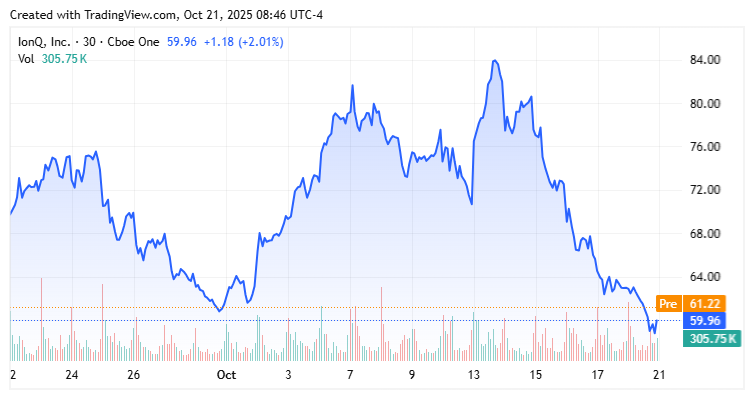
IonQ Inc. is preparing to report third-quarter results next week, with analysts expecting revenue of approximately $27 million and full-year guidance between $82 million and $100 million. The company's rapid progress in quantum hardware and networking comes as investors evaluate how quickly these technological breakthroughs can translate into sustainable profits. The College Park, Maryland-based firm recently secured a $1 billion equity investment from Susquehanna International Group, bringing total cash reserves to roughly $1.68 billion while maintaining a debt-free balance sheet that represents one of the strongest financial positions in the emerging quantum computing sector.
The company's strategic acquisitions have reshaped its technology trajectory significantly. IonQ's purchase of Oxford Ionics brought ion-trapping chips designed to integrate millions of qubits using existing semiconductor processes, while the acquisition of Lightsynq added photonic interconnects aimed at linking these chips into modular systems. At a recent analyst day, Oxford Ionics co-founder Chris Ballance noted that approximately 95% of the hardware design overlaps with IonQ's existing systems, allowing the company to leverage mature chip fabrication infrastructure and what he described as "trillions of dollars in prior semiconductor R&D" to dramatically reduce costs.
IonQ's expanding partnerships demonstrate the company's broadening reach beyond pure computation. Collaborations with ID Quantique position the company in secure communications through quantum key distribution technology already deployed by governments and financial institutions. Partnerships with Capella Space expand IonQ's footprint into satellite-based entanglement and space-based quantum networking. The company's second-quarter results showed revenue of $20.7 million, exceeding expectations by 15%, driven primarily by federal contracts with the Department of Energy and the Air Force Research Laboratory.
The company's collaboration with AstraZeneca, Nvidia, and Amazon Web Services has demonstrated tangible performance gains, including a 20-fold increase in speed for drug discovery simulations. Additional partnerships with Oak Ridge National Laboratory, General Dynamics, and Ansys aim to apply quantum systems to logistics and energy-grid optimization. IonQ's expanding software stack, incorporating an in-house operating system, job scheduler, and domain-specific libraries, creates what analysts describe as a defensible moat that mimics a SaaS model with recurring revenue potential as hybrid workloads scale toward full quantum processing.
IonQ shares have climbed more than 110% this year, reflecting enthusiasm for both execution and financial strength. The company's enterprise value now stands near $20.7 billion, giving it a forward EV-to-sales multiple of 227 times—a steep valuation even for high-growth technology firms. By comparison, Rigetti Computing trades at an EV-to-sales multiple exceeding 1,500, and D-Wave Quantum around 445, ratios that underscore investor willingness to pay for exposure to a potentially transformative field. Operating expenses have risen sharply, with research-and-development spending increasing more than 230% year over year to $181 million in the second quarter, while the company posted an adjusted EBITDA loss of $36.5 million, reflecting its strategy of prioritizing capability over cost control.
The central challenge for IonQ remains the timing of commercialization. Delivering fault-tolerant quantum systems before 2030 would mark a major milestone, but realizing broad demand at scale will depend on cost, reliability, and customer adoption beyond pilot programs. Integration risks from Oxford Ionics and Lightsynq acquisitions, combined with ongoing heavy R&D spending, could pressure margins and potentially prompt future equity dilution if revenue growth lags. For now, IonQ's $1.6 billion cash cushion provides a substantial runway to execute its ambitious targets of 800 logical qubits by 2027 and 80,000 by 2030—a scale that could push quantum computing toward meaningful commercial viability.