Eldridge Engineers Combat Cold Storage Hazards Through Psychrometric Analysis
Eldridge engineers are using psychrometric charts to address humidity-related safety and efficiency challenges in cold storage facilities, shifting from reactive problem-solving to proactive prevention.
In cold storage facilities where temperature typically dominates operational concerns, moisture has emerged as the primary threat to safety, efficiency, and profitability according to Eldridge, a leading provider of industrial ventilation and dehumidification solutions. Clayton Settle, Project Manager at Eldridge, emphasized that humidity serves as the silent saboteur in temperature-controlled environments, with the solution beginning with understanding air properties through psychrometric analysis.
Cold storage facilities operating between 0°F and 40°F face amplified humidity challenges when warm, moist air infiltrates the controlled environment. This moisture intrusion creates three significant problems: coil frosting that insulates cooling systems and reduces efficiency, icing and fogging hazards that endanger workers and equipment through rapid flash-freezing and poor visibility, and energy waste from frequent defrost cycles and latent heat removal. Settle explained that the dew point, rather than simple temperature readings, determines success in cold storage design.
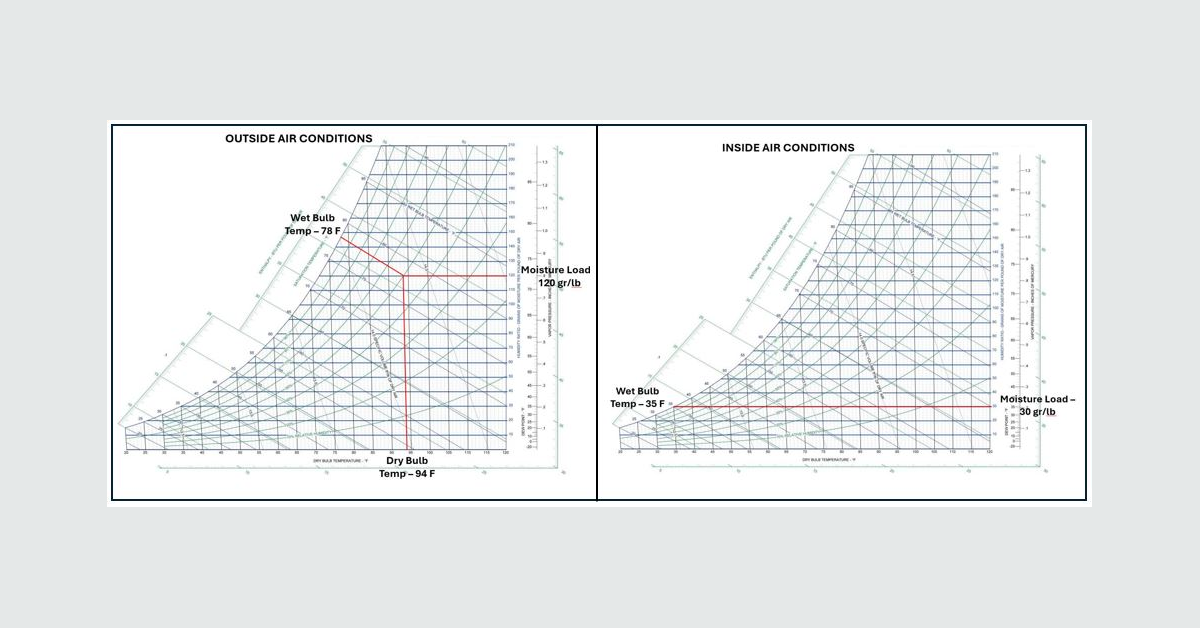
Eldridge engineers are implementing psychrometric charts to model and control air's thermodynamic properties, transforming industrial humidity management. By plotting dry-bulb, wet-bulb, and dew point temperatures, engineers can visualize condensation and frost formation points, then design ventilation and dehumidification systems that maintain air safely below its dew point. In a recent application documented at https://www.eldridgeusa.com/case-studies, the company modeled outside air at 94°F dry-bulb with 78°F wet-bulb temperatures against a 35°F cold storage environment, using the resulting 90-grains-per-pound moisture differential to precisely size desiccant dehumidifiers.
The psychrometric approach represents a fundamental shift from reactive to proactive safety management in cold-chain operations. By understanding air behavior in advance, facility managers can identify high-risk zones, reduce maintenance cycles, and protect workers before hazards materialize. This methodology, detailed in technical resources available at https://www.eldridgeusa.com/psychrometric-charts, enables companies to prevent problems rather than simply reacting to them, representing what Settle characterizes as smarter engineering rather than simply colder air implementation.