Maryland's Research Sector at Risk as Federal Funding Cuts Loom
The article explores the potential economic and scientific repercussions of federal funding cuts on Maryland's research institutions and biotech industry, highlighting the urgent need for state intervention.
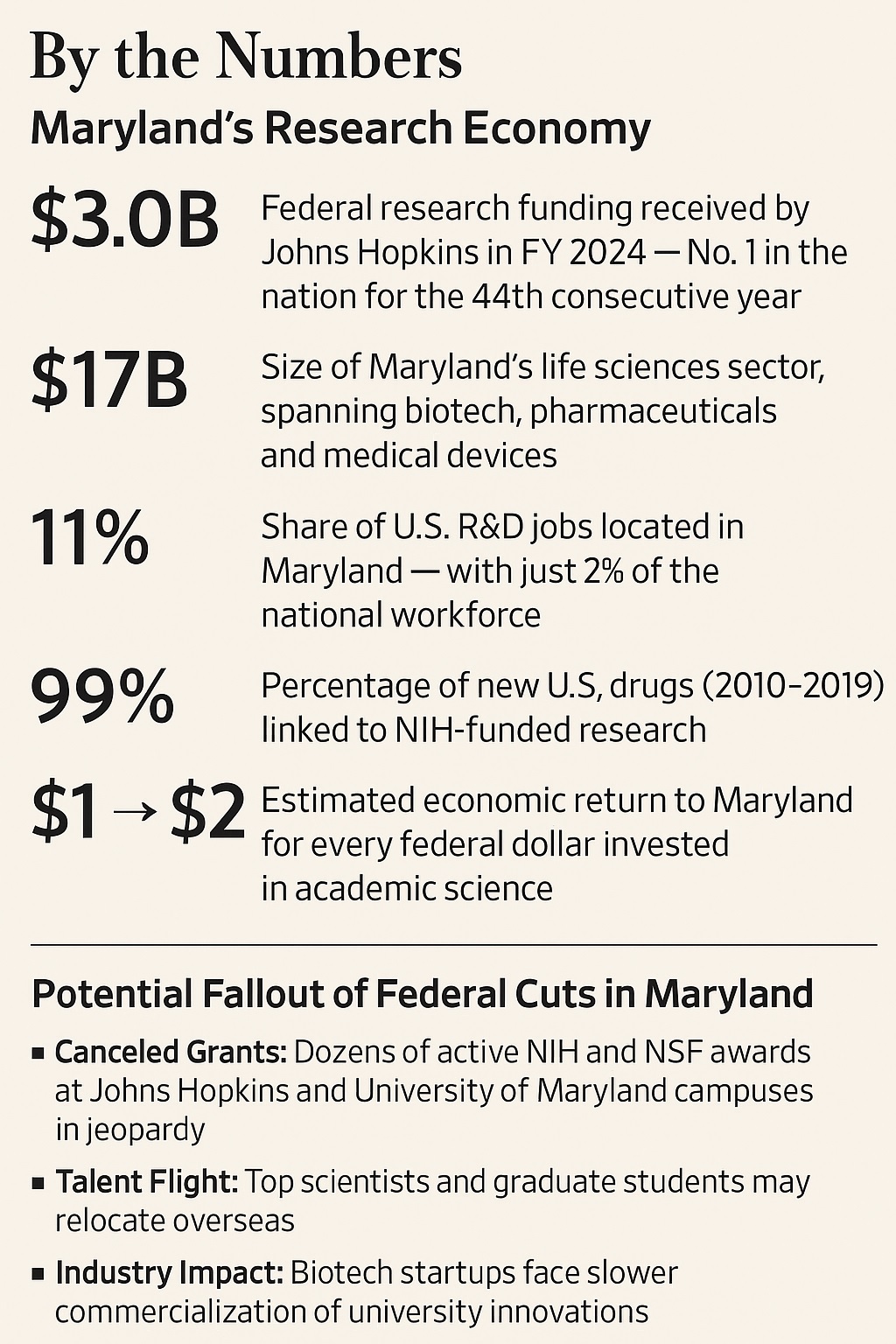
Maryland's position as a leader in scientific research and biotech innovation is under threat due to significant federal funding cuts proposed by the Trump administration. With Johns Hopkins University, the nation's top recipient of federal research dollars, and a $17 billion life sciences sector at stake, the state faces a critical challenge to sustain its research ecosystem.
The proposed cuts target over $3 billion in federal research spending nationwide, with substantial reductions in grants from the National Institutes of Health (NIH) and the National Science Foundation (NSF). These funds are vital for ongoing research in areas such as cancer immunotherapies and artificial intelligence, which not only advance scientific knowledge but also drive economic growth through biotech startups and high-paying jobs.
University research serves as the backbone of Maryland's life sciences sector, encompassing global pharmaceutical companies, emerging biotech firms, and a dense network of federal R&D facilities. The fragility of basic research, dependent on continuous grant funding, means that cuts could lead to stalled projects, lost talent, and missed discoveries. A senior administrator at Johns Hopkins emphasized the detrimental impact of funding instability on scientific progress.
In response to similar challenges, Massachusetts has proposed a $400 million plan to support its research institutions. Maryland, however, has yet to announce a comparable strategy. Policy analysts suggest the establishment of an emergency R&D fund, potentially funded by corporations, philanthropies, and venture investors, to bridge the gap left by federal cuts. This approach would leverage the existing peer-review process of federal grants, allowing the state to support approved projects without delving into scientific evaluations.
The economic implications of research funding extend beyond academia. From 1996 to 2020, academic research in the U.S. contributed significantly to patent generation, company formation, and GDP growth. In Maryland, the research sector is a key driver of high-skill employment and venture capital investment, underpinned by institutions like Johns Hopkins and the University of Maryland system.
Without immediate action, Maryland risks losing its competitive edge in scientific research to other states and countries actively increasing their research funding. The state's leaders are urged to consider measures such as creating an emergency R&D bridge fund, offering matching grants, expanding research tax credits, and forming public-private innovation consortia to safeguard its research infrastructure and economic future.